

Consents tab
The Consents tab holds every formal agreement your client has signed with the firm: engagement letter, retainer, scope-of-work, translator certificate, and any custom consents you’ve authored.
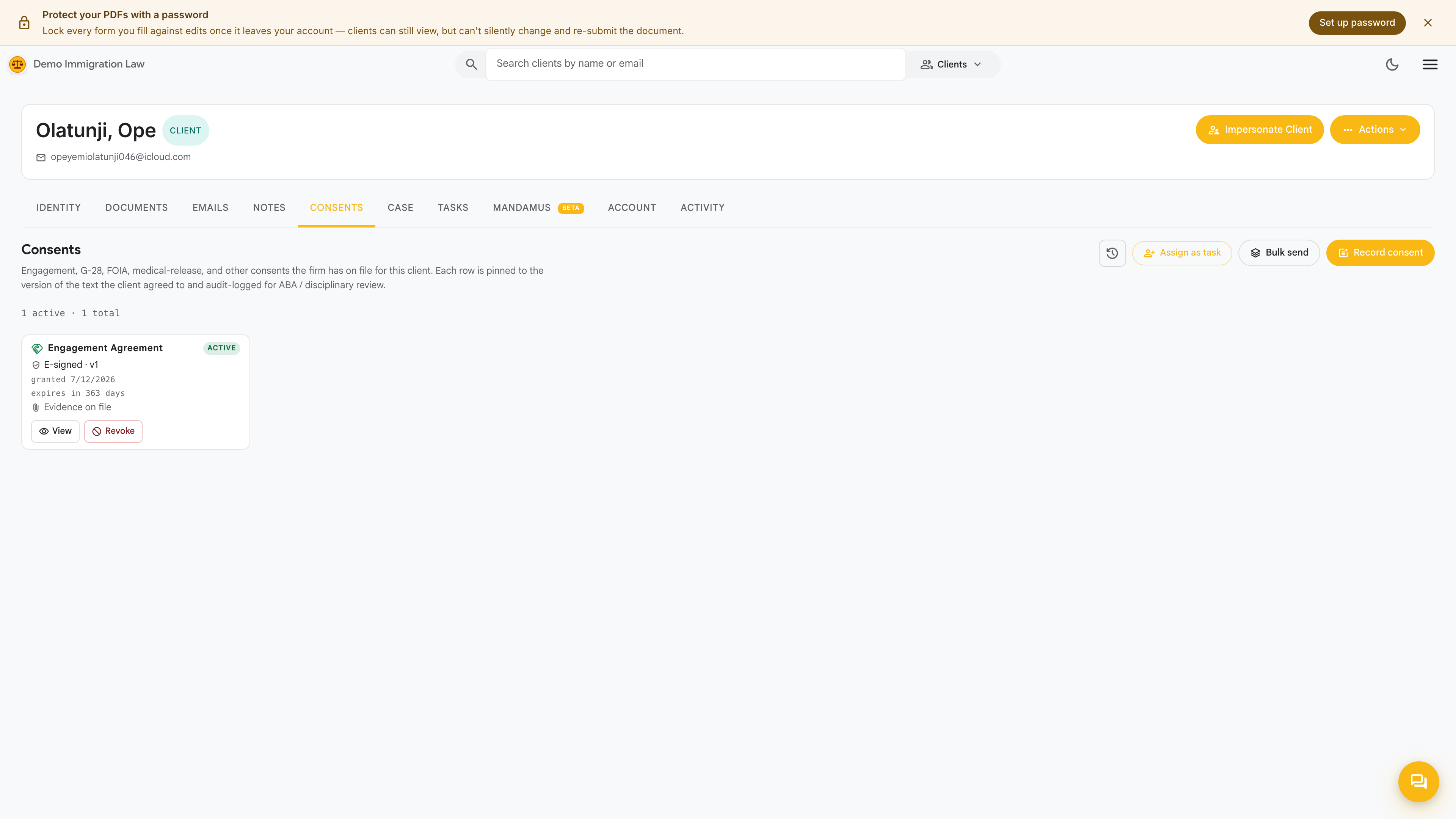
What’s here by default
Section titled “What’s here by default”Your workspace ships a starter set of consent templates that appear on every new client until you customize them under Administrative → Email & consent templates:
- Engagement letter — the standard contract that opens the attorney-client relationship
- Limited-scope representation — for when you’re handling only part of a matter
- Flat-fee agreement — fee structure as a flat amount
- Hourly fee agreement — fee structure billed by the hour
- Translator certificate — non-English-speaking clients sign this when a translator helped them understand documents
You can edit any template, mark some active and others inactive, or add your own — all under your firm’s brand.
Sending a consent for signature
Section titled “Sending a consent for signature”From this tab, click the consent you want the client to sign. You’ll see two options:
- Sign in person — opens a signature pad on your screen; hand the device to your client, they draw their signature, you save. Best for in-office signings.
- Send link to client — generates a one-time-use signing URL and either copies it to your clipboard or sends it through your firm’s consent-request email template. Best for remote clients.
Both paths use the same drawn-signature canvas (mouse, trackpad, or touchscreen). The resulting signed PDF saves to this tab permanently and also lands on the Documents tab under “Consents”.
What gets recorded with each signature
Section titled “What gets recorded with each signature”Every signed consent carries:
- The full text of the consent at the time of signing (preserved verbatim, so a future template edit doesn’t change what the client already agreed to)
- The signer’s full legal name + title
- The drawn signature image
- The signing timestamp
- IP address + user-agent of the signing device
That’s the audit trail you’d hand to a court or bar association if a signing is ever challenged.
When to require a re-sign
Section titled “When to require a re-sign”A few scenarios where you should generate a fresh signature on the same template:
- The client’s case scope changed — they came in for an I-130 but you’re now also handling their child’s I-485. New engagement letter.
- A material template edit — you raised the flat fee. Resend the updated fee agreement.
- Fee dispute — if the client claims they didn’t agree to hourly billing, a re-sign documents the new understanding.
Was this page helpful?
Thanks — noted.